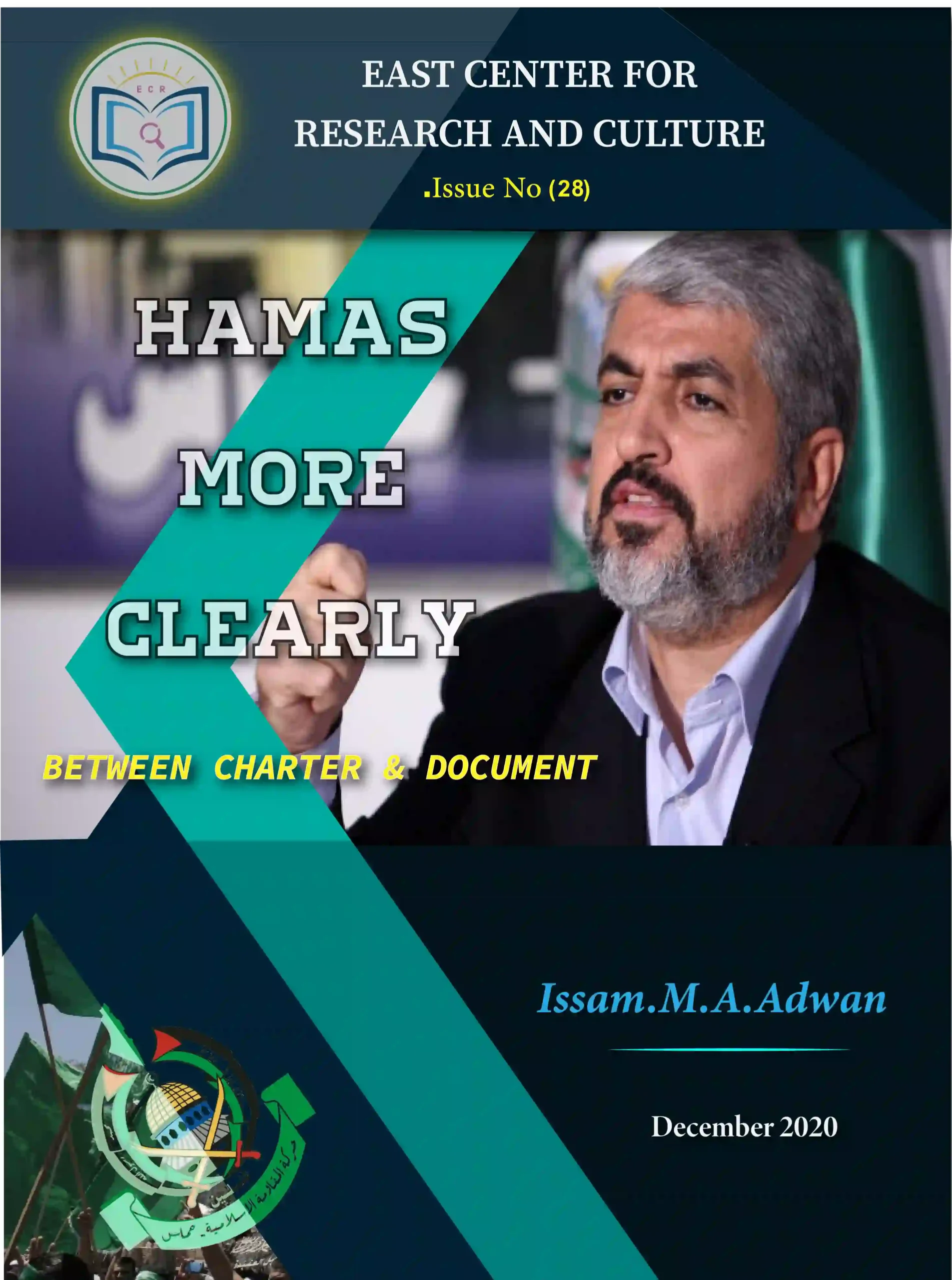


Are you looking for an academic study that explains how Hamas changed its political language between its 1988 Charter and its 2017 Political Document? “Hamas More Clearly: Between Charter & Document” provides a focused analytical reading of one of the most important transformations in the discourse of the Islamic Resistance Movement.
At first, the book examines the original Hamas Charter of 1988, which was issued during the early stage of the movement’s emergence. This charter reflected the ideological, religious, political, and resistance-based foundations of Hamas at that time. Therefore, it became a key reference for understanding the movement’s early identity, objectives, and worldview.
However, the study does not stop at the 1988 charter. It moves carefully to the 2017 document, officially titled “Principles and General Policies.” This later document redefined Hamas, its objectives, its political language, and its position on major Palestinian issues. As a result, the book allows readers to compare two different stages in the movement’s political development.
Moreover, the book analyzes how Hamas presented itself in 2017 as a Palestinian national liberation movement. This shift is significant because the 1988 charter used a much stronger religious and ideological framework. In contrast, the 2017 document adopted a more political, national, and modern language.
The study also highlights how the 2017 document focused more clearly on the Palestinian identity of Hamas. It gave greater emphasis to Palestine, the Palestinian people, Jerusalem, refugees, and the right of return. In addition, it addressed issues that were either absent or less developed in the 1988 charter.
On the other hand, the book investigates the Islamic dimension of Hamas. It shows that the 2017 document did not abandon the Islamic reference of the movement. Rather, it presented that reference in a more limited and politically balanced form. Therefore, the study helps readers understand how Hamas tried to balance its Islamic identity with its Palestinian national identity.
The book also examines the movement’s position on Judaism, Zionism, and Israel. It explains how the 1988 charter often merged these terms in hostile language, while the 2017 document made a clearer distinction between Judaism as a religion, Zionism as a political project, and Israel as an occupying entity. Consequently, the book is useful for readers studying the evolution of political discourse in Palestinian resistance movements.
Furthermore, the research studies Hamas’s position toward the Palestine Liberation Organization (PLO), the Palestinian state, partial solutions, resistance, settlement projects, and international political pressures. Thus, the book is not only about textual comparison. It is also about political transformation, strategic adaptation, and the changing regional and international environment.
The author relies on analytical, comparative, content-analysis, and inductive methodologies. In addition, the study uses Hamas-related documents, statements, writings, oral accounts, and primary sources. This gives the book academic value for researchers, students, and readers interested in Palestinian political movements.
Therefore, “Hamas More Clearly” is an important reference for anyone studying Hamas, Palestinian political Islam, liberation movements, the Palestinian cause, or the development of political documents in the Arab-Israeli conflict.
You may also explore more Palestinian political studies in our store to enrich your research library with documented academic works on Palestinian movements and modern Middle Eastern politics.
Book Themes and Academic Scope
The book is organized around key political and documentary themes that help readers understand the shift between the 1988 charter and the 2017 document:
- First, Hamas Charter 1988:
The study examines the original charter as a foundational text that defined Hamas’s early ideology, objectives, structure, and political worldview. - Second, Hamas Political Document 2017:
The book analyzes the later document titled “Principles and General Policies”, which redefined Hamas through a more modern and national political language. - Third, Hamas’s Objectives and Goals:
The research compares the objectives stated in the 1988 charter with those presented in the 2017 document. It highlights what was retained, modified, or dropped. - Fourth, Defining the Movement:
The book explains how Hamas moved from a strongly religious and jihad-oriented definition toward the description of itself as a liberation movement. - Fifth, Palestinian Identity:
The study shows how the 2017 document emphasized the Palestinian people, Palestinian national decision-making, and the Palestinian dimension of the struggle. - Sixth, Islamic Dimension:
The book analyzes the reduced religious intensity in the 2017 document, while noting that Hamas still maintained Islam as a reference for principles, objectives, and means. - Seventh, Jerusalem, Refugees, and Right of Return:
The research explains how the 2017 document addressed Jerusalem, refugees, and the right of return more explicitly than the 1988 charter. - Eighth, Judaism, Zionism, and Israel:
The book studies the movement’s evolving language regarding Jews, Zionism, and Israel, and how the 2017 document distinguished more clearly between these terms. - Ninth, Liberation and Settlement:
The study examines Hamas’s position on liberation, armed resistance, settlement projects, Oslo, partial solutions, and the 1967-state formula. - Tenth, Hamas and the PLO:
The book discusses Hamas’s view of the Palestine Liberation Organization and its place within the wider Palestinian political system.
Why Is This Book Important?
The importance of “Hamas More Clearly” lies in its careful comparison between two major documents in the political history of Hamas. The 1988 charter reflected the movement’s early ideological formation. Meanwhile, the 2017 document reflected a later stage shaped by regional change, political pressure, and the need for a clearer international presentation.
In addition, the book helps readers understand how political movements revise their language without necessarily abandoning all of their founding principles. This makes the study valuable for researchers interested in political adaptation, resistance movements, and ideological development.
From another perspective, the book is useful because it explains the shift from broad Islamic discourse to a more Palestinian national discourse. It also shows how Hamas attempted to present itself as a liberation movement with a defined national cause.
Furthermore, the book is written in English. Therefore, it is suitable for international readers, academic libraries, university courses, researchers, and policy analysts interested in Hamas, Palestinian politics, and the Arab-Israeli conflict.
As a result, this book is a strong addition to any collection focused on Palestinian studies, political Islam, liberation movements, Middle Eastern politics, and modern Palestinian history.
Recommended External Links
- Hamas – Wikipedia
- Hamas Charter – Wikipedia
- Palestinian Political Violence – Wikipedia
- Palestine Liberation Organization – Wikipedia
- Palestinian Right of Return – Wikipedia
- Arab-Israeli Conflict – Wikipedia
Technical Product Information
- Book Title: Hamas More Clearly: Between Charter & Document.
- Author / Preparation: Issam M. A. Adwan.
- Academic Title: Professor of Modern and Contemporary History, Al-Quds Open University.
- Publisher: East Center for Research and Culture.
- Issue Number: Issue No. 28.
- Publication Date: December 2020.
- Edition: First Edition.
- File Format: Digital PDF.
- Language: English.
- Number of Pages: 54 pages.
- ISBN: 978-9950-06-026-5.